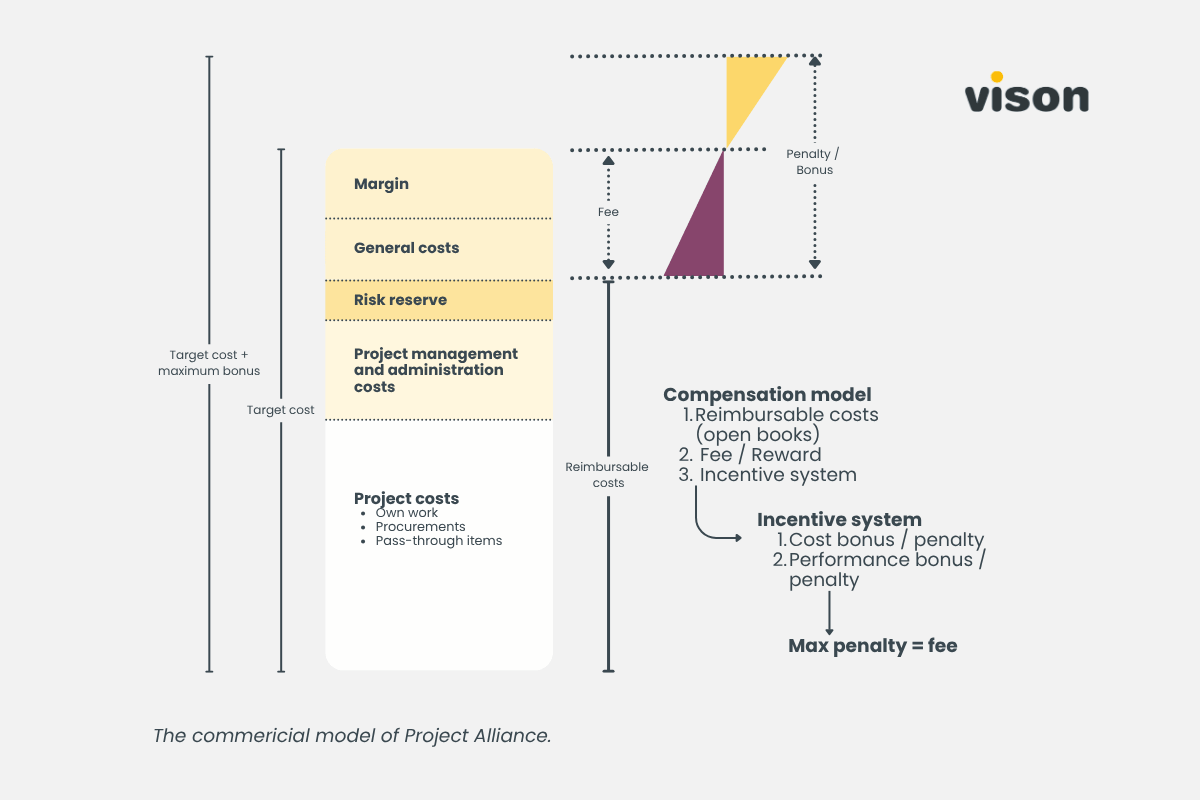
The commercial model is one of the main ways Project Alliance ensures that the owner and partner organisations make decisions based on shared project outcomes rather than separate organisational interests. Its purpose is to ensure that all parties are motivated to act in the best interest of overall project performance rather than individual positions.
Transparency creates the basis for joint decisions
The commercial model is based on open-book cost management. Direct project costs, key assumptions and risk provisions are visible to all alliance partners, creating a transparent basis for cost steering and decision-making.
The target cost gives the alliance a common reference point
Cost performance is measured against the Target Outturn Cost. This target is developed during the development phase and validated against the allowable cost derived from the owner’s business case.
The Target Outturn Cost functions as the shared financial reference point for the alliance organisation.
Shared consequences change how parties act
Alliance projects use a gainshare–painshare structure to link financial outcomes to project performance. If final costs are below the target, the benefit is shared between the owner and alliance partners. If costs exceed the target, the impact is also shared in accordance with pre-agreed rules.
This connects financial outcomes to collective performance rather than individual contractual positions.
Incentives beyond cost performance
Incentives are often linked to Key Result Areas defined by the owner, such as safety, quality, sustainability, schedule performance and user value. This helps steer the alliance toward balanced project outcomes rather than cost efficiency alone.
Through these mechanisms, the alliance commercial model supports collaboration and shared responsibility for results.
Learn more about the alliance model in the Alliance Report 2026. Download it below!